We recently organised a successful union rally and march. We had colour, energy, music, clear messages and community support. Unfortunately, through a lack of planning and preparation, we missed the opportunity to capture the event effectively on video and in photos.
We did get some decent photos:
And some video which captured the colour and energy:
Most of our video, however, was unusable. Great long lengths of shaky footage that was unfocused in terms of both cinematography and content. When we had should have video of members speaking, we had pictures of sausages being sizzled. And no interviews or vox pops from activists or the community supporters.
This happened because we hadn't assigned anyone the role of videoing or taking photos. The handycam was given to a marshall just as the march started. We hadn't identified what we wanted to video or given any training.
Next time we will video the speeches and the participants. We'll be asking people who they are, what action they're involved in, why they're doing it and how it feels. And we'll have people assigned to video and camera duty - people who've been shown what to do and been given an idea of what to capture.
Friday, 5 November 2010


Tuesday, 15 June 2010
Integrating On-line and Off-line Organising - A Case Study
A recent conference of NZEI school support staff union members led to an opportunity to intergrate some on and off-line organising. The conference was to have a professionally focused ICT workshop but I had the opportunity to discuss this with some conference organising committee members at a union leadership development course. They decided instead to focus the workshop on using the union's on-line networking and campaigning sites. Intitally they asked me to run the workshop but as I was unable I decided to look for a member who could run it. That proved fairly easy as all I had to do was look at the site and see who have been active and had engagaed in a number of different ways. One local member, Linda, stood out. I approached her about running the workshop and after she had agreed I worked with her on the workshop content.
Here are a couple of photos of the conference workshop.


The venue suffered from dodgy internet but Linda ran the workshop successfully resulting in new members signing up and a few of these people quickly adding content and comment. Linda asked all of the workshop participants to agree to an on-line task and because she has met these peole she is going to follow up with them.
Here's an email I got from Linda following the workshop.

Here are a couple of photos of the conference workshop.


The venue suffered from dodgy internet but Linda ran the workshop successfully resulting in new members signing up and a few of these people quickly adding content and comment. Linda asked all of the workshop participants to agree to an on-line task and because she has met these peole she is going to follow up with them.
Here's an email I got from Linda following the workshop.

Wednesday, 9 June 2010
Glogster: A New Tool Worth Trying?
A friend recently tweeted about a video made by a US school student on her Personal Learning Environment. Watching the video I noticed one of the tools she was using that I hadn't come across before - a glog. I checked it out and, while it's mainly the utilised by emo kids creating paean's to teen angst, it does seem to offer some opportunities for collective engagement around an issue or event.
A Glog is basically an on-line collage poster. You collect bits and pieces of text, images, video, links and sound and place them on a web page. It's highly configurable and there are a number of templates and tools you can utilise. (I found a useful glog tutorial on Slideshare)
Delegates could use it to create an on-line resource about a workplace or sector issue, or it could be utilised to reinforce learning at union education.
The Glog is a free resource that seems to be funded by advertising on the Glogster.com homepage. The glog itself can be visited as a stand-alone site or you can embed them into other sites. The glog can be public or private.
I had a play and created this glog to try the tools out. I've embedded it below, or you can visit the stand-alone page for a better viewing experience.
A Glog is basically an on-line collage poster. You collect bits and pieces of text, images, video, links and sound and place them on a web page. It's highly configurable and there are a number of templates and tools you can utilise. (I found a useful glog tutorial on Slideshare)
Delegates could use it to create an on-line resource about a workplace or sector issue, or it could be utilised to reinforce learning at union education.
The Glog is a free resource that seems to be funded by advertising on the Glogster.com homepage. The glog itself can be visited as a stand-alone site or you can embed them into other sites. The glog can be public or private.
I had a play and created this glog to try the tools out. I've embedded it below, or you can visit the stand-alone page for a better viewing experience.

Saturday, 24 April 2010
Union Social Networking Tutorials
When I started developing tutorials for NZEI members on how to engage with their union through the internet I started with explanations of all the sites the union had and the difference between them. But it was soon obvious that this was the wrong approach, it just wasn't engaging. So then I started to think about what it was that I actually hoped union members would do on-line and began tutorials around these themes - follow, share, create.
The first on-line tutorial I developed covered how to follow union information through RSS and email. Here are two more. One explains how to join the union's social networking sites and the second how to share on-line content.
The first on-line tutorial I developed covered how to follow union information through RSS and email. Here are two more. One explains how to join the union's social networking sites and the second how to share on-line content.
Monday, 12 April 2010
Web 2.0 How-To
For a long time unions have taken a "build it and they will come" approach to their on-line presence. However, if we want members to engage with their union on-line we need to educate and support this, in the same way we do for other union activity. That, and my observation that many people get a glazed over look when you mention RSS, has prompted me to start developing resources and modules that can be used to educate union members how to engage with their union on the web. This is my first support resource, destined for a Web 2.0 How-To page on my union's website.
Thursday, 25 March 2010
Marshall Ganz on Organising
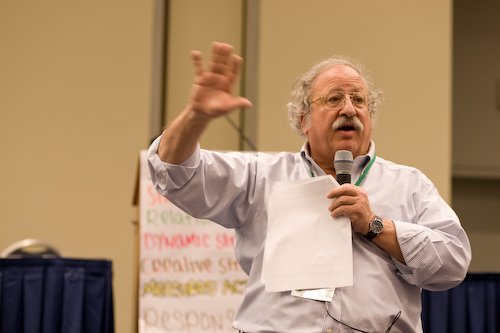
Professor Marshall Ganz is a long-time organiser and trainer who worked on Barack Obama's grassroots presidential election campaign.
As well as his acclaimed organising campaign work for Obama and his earlier work with the United Farm Workers (alongside Cesar Chavez) Ganz has held roles as a lecturer in Public Policy at the Kennedy School of Government, Harvard University and a principal of Harvard’s Hauser Center for Nonprofit Organizations.
Ganz has put together a series of seven web modules on organising covering some of the key concepts and practical strategies. Each module has downloadable lecture notes and streaming video of the accompanying lecture. This vignette gives a taster for the series.
The lectures are insightful and, because of Ganz's experience and easy-going manner, easy to digest. The series has been put on-line as a resource for organisers, and social change educators. As well as the lecture notes and videos there are links and teaching resources – syllabi and examples of facilitation guides.
I highly recommend this to anyone interested in organising or union education. However, one small grumble - the videos are in real media format and the site recommends RealPlayer. That player has been the subject of much criticism and many people don't want to install it. There is an alternative called Real Alternative which will allow you to watch the videos.
Tuesday, 15 December 2009
Michael Newman: Dismay, Anger, Hate & Love
Having written books such as Defining The Enemy and Teaching Defiance it's no surprise that Michael Newman advocates a passionate and politically positioned role for adult educators. If we are educating to bring about social change he argues we must deal with strong emotions such as anger, hate and love. He also maintains we must acknowledge tensions in our beliefs; we may recoil from violence but we can't deny that sometimes it works to bring about change for the better. Far from being a firebrand Newman believes these strong emotions are the basis of a moral and principled approach to how we go about our role in activist and union education. He explored these ideas in a talk to union educators at the 2009 Trans Tasman Union Educators Conference in a large echoey room at Union NSW, Sydney.
Download podcast: 64kbps mp3 or 128kbps mp3
Download podcast: 64kbps mp3 or 128kbps mp3
Monday, 7 December 2009
Michael Newman Aspects of Learning Podcast
Amongst the highlights of the 2009 Trans-Tasman Union Educators Conference were the two addresses from Michael Newman. Michael's talk were thought-provoking and, sometimes, controversial - in particular his comments about the place of hate in union education. Many of us found his talks inspiring and a catalyst for reflection on our practice as union educators. Many thanks to Michael for agreeing to have his talks recorded and made available on-line.
This is the first of two recordings. This talk on Aspects of Good Learning was delivered on the opening morning of the conference.
Download podcast: 64kbps mp3 or 128kbps mp3
Michael Newman Aspects of Learning
This is the first of two recordings. This talk on Aspects of Good Learning was delivered on the opening morning of the conference.
Download podcast: 64kbps mp3 or 128kbps mp3
Michael Newman Aspects of Learning
Unions On-Line Wiki
In conjunction with the workshop I co-presented at the Trans-Tasman Union Educators Conference in Sydney in November I have started a wiki as a collaborative space for union educators who are interested in supporting and encouraging on-line union engagement and activity.
The wiki is Unions On-Line. If you join you can edit and add content to the site. The principle behind the wiki is the same as the inspiration and purpose for this blog. However, I hope that the wiki format will encourage participation and collaboration amongst union educators. At the conference we utilised the wiki as a place to create a plan for an education module on introducing union members to twitter. One of the hopes I have for the wiki is that more of this type of sharing will occur. The wiki also allows for the working and philosophy of the development of education for on-line activity to be open and up for discussion. Please visit and consider joining to add your ideas.
This blog will remain as space for my musings on union education and on-line union activity.
The wiki is Unions On-Line. If you join you can edit and add content to the site. The principle behind the wiki is the same as the inspiration and purpose for this blog. However, I hope that the wiki format will encourage participation and collaboration amongst union educators. At the conference we utilised the wiki as a place to create a plan for an education module on introducing union members to twitter. One of the hopes I have for the wiki is that more of this type of sharing will occur. The wiki also allows for the working and philosophy of the development of education for on-line activity to be open and up for discussion. Please visit and consider joining to add your ideas.
This blog will remain as space for my musings on union education and on-line union activity.
Tuesday, 3 November 2009
Educating for Social Networking for Social Change
 At the Australasian Union Educators Conference I'll be running a workshop on the role of union educators in educating and supporting people to utilise social networking and web tools for union activity. There are so many tools that allow people to come together on-line to discuss, debate and plan that it seems union activity and engagement should be an inevitable outcome. However, the on-line presence of many unions is flat and un-engaging, and even attempts to use Web 2.0 and social networking have often not had the pick-up or the impact we may have hoped for.
The problem may be that we just expect members to pick up these tools and use them successfully. Actually, just like any other organising we want our members to participate in, we need to have a clear purpose, develop understanding and support people's developing ability to use them if they are to be successful.
There are some particular issues to contend with - lack of web and tech skills amongst union educators, uncertainty about the involvement of educators in an area that may be seen as the doman of the webmaster, variable web access amongst members and nervousness about the lack of control over the views expressed to name a few. However, even if we can deal with these issues it still remains that we need to have a planned approach to encouraging worker engagement that is grounded in the same principles that shape our approach to union education for face to face organising.
Monday, 2 November 2009
Michael Newman
 When I first started working as an educator in the union movement a colleague, Dr Joce Jesson, introduced me to a book by unionist and educator Michael Newman, The Third Contract. Over the last seven years I've returned to this book and others by Newman time and time again. Based on his experiences and observations as a union educator Newman describes the potential of union education to engage and empower in a way that I find deeply insightful and inspirational. Newman examines the relationships of power in union education and challenges educators do the same. He argues that the real power of union education is unleashed when educators adopt a radical stance envisioning the union not as the organisation they work for but as the sum of it's members. The Third Contract is a must-read for anyone working in the field of union or social change education and is available as a free pdf download from Michael Newman's website.
Michael Newman will speak at the Australasian Union Educators Conference 24-26 November 2009.
Thursday, 23 July 2009
Using Video and YouTube
I've started a Union Education YouTube channel to collect togther videos that are either about, or could be used in union education. If you have suggestions of videos that could be added to the channel or ideas about how video and youtube can be utilised in union education please leave suggestions and discussions in a comment.
http://www.youtube.com/user/unioneducation
http://www.youtube.com/user/unioneducation
Monday, 20 July 2009
Tuesday, 19 May 2009
Union Member Activity on Ning

NZEI is the union for school support staff in New Zealand, people like school office staff, teacher aides, librarians etc. Many of these people are very poorly paid and have limited job security, facing cuts to hours or being laid off if wages are increased. NZEI has mounted a Fair Deal campaign for support staff. A key focus of the campaign is development of member leadership and activism. This represents a considerable shift in the way the union has worked in the past - the focus on member driven activity is exciting, and challenging.
As part of the campaign a Fair Deal Ning has been set up. There is some staff input - this was particularly important at the beginning to get the ball rolling but now the bulk of the Ning members are union members. The site had a real boost when support staff participated in a day of action meaning there were plenty of photos and video to add. The focus of current comments is around support for the negotiation team bargaining the support staff collective agreement. Letting members have their head and speak out without carefully shaping the message is something very new for NZEI and is a welcome development.
I see the staff role as bring the Ning to the attention of members and showing them how to use it. It will interesting to see if the momentum can be maintained. I would be interested in hearing of other examples of unions using Nings or other similar sites and particularly the role of union staff with these.
Tuesday, 21 April 2009
Written Information in Union Education
This isn't so much about union education pedagogy, and may seem a little trivial, but what font do you use for written information and handouts in union education? Obviously we want things to be clear and easily read, but have you considered the impression you give, or want to give with your choice of font? I personally favour the sans serif fonts - lately I've been using Calibri, and Arial is a common fallback, but what would work best to convey the political message of union education? Not, I'd wager, Comic Sans.
Comic Sans from Sam and Anita on Vimeo.
Comic Sans from Sam and Anita on Vimeo.
Wednesday, 8 April 2009
Ning Ning
I was recently introduced to Ning through a community project I'm involved with. Ning is a free on-line platform for blogging and social networking. It has all the blog posting features that you'll be familiar with but combines these with a membership facility. Members can communicate directly with each other through comments, or groups can be formed where discussions can be held. The basic platform is very flexible and you can easily introduce a number of widgets and features. There is also the option to pay for additional features such as hosting on your own domain name, removing the google ads etc.
What I like about Ning is that the discussion and interaction elements are to the fore-front - much more so than on a blog. I've been looking around for an on-line platform that is about more than just reporting and would lend itself to collective engagement and I'm quite impressed with Ning so far.
I decided to take a look and see whether unions had been picking up on Ning (there's a Ning search facility). Through that I came across UnionSocialMedia.org, a network for people who want their "union to make better use of new media and communications tools". I've joined up and you'll find a badge on the sidebar if you're interested. Thee is currently a really interesting discussion about the potential of twitter for union organising and activity.
What I like about Ning is that the discussion and interaction elements are to the fore-front - much more so than on a blog. I've been looking around for an on-line platform that is about more than just reporting and would lend itself to collective engagement and I'm quite impressed with Ning so far.
I decided to take a look and see whether unions had been picking up on Ning (there's a Ning search facility). Through that I came across UnionSocialMedia.org, a network for people who want their "union to make better use of new media and communications tools". I've joined up and you'll find a badge on the sidebar if you're interested. Thee is currently a really interesting discussion about the potential of twitter for union organising and activity.
Thursday, 19 February 2009
Fabulous Tools for Fabulous Folks
The opportunity that new technology opens is endless. Communications that cannot happen face to face can now be continued online, overtime, and with new and better tools for creation than the old union hall could ever muster.
The keepers of the means of production attempt to assert control over the lives of their workers by being the gateway through which all thought and expression. We must support the freedom of access to information and education in all workplaces. Starting with our own…
union blogs rocs - considering the uses of tech in union education
We could use this in a workshop setting to develop delegates/activists/organisers communication & campaign skills.
Re: Using technology in education
Yay Chris!
How enlightening! We have learnt that the union education blog spot shows us that blogs can be a tool for learning rep trainees in the following ways:
- to link to our learning reps website
- to hold uploaded videos from our courses, this will help people to remember key points from our workshops when they are doing their workbooks.
- allows us to set up a chat group so people can keep in touch after the course
- hold pictures and images from the training course,
- able to hold voice recordings of people endorsing our programme and other training eg other learning reps, employers, union leaders etc
This will allow for the learning to continue after the workshop has finished!
cheers
from the 3 women at the middle table
What About Social Networking?
There are lots of really popular social networking sites that lend themselves to collective participation and networking but many union attempts have fallen flat. Here is an introduction to social networking.
There is now also a specific union social networking site - Unionbook
There is now also a specific union social networking site - Unionbook
Subscribe to:
Posts (Atom)